America has a talent for adopting “one more hand” games—rules you can teach in minutes, but outcomes you still argue about an hour later. That’s the lane five crowns in United States quietly owns: familiar enough for rummy fans, strange enough to stay interesting, and social enough to survive phones on the table.
It doesn’t feel like a collector’s hobby. It feels like something you keep in a drawer and pull out when the room needs a shared rhythm.
From a kitchen-table problem to a 1996 release
Five Crowns was published in the mid-1990s by Set Enterprises, with the game commonly credited to designer Marsha J. Falco and a release date of 1996. The backstory that often circulates around Falco’s designs is practical rather than theatrical: games built to solve a real-life “we need something better to play” situation, then refined into something other people wanted too.
Over time, Five Crowns became associated with PlayMonster as part of the SET/PlayMonster family of games, which helps explain why it stayed visible in U.S. retail channels instead of fading into “remember that one card game?” territory.
The twist Americans remember: five suits and a moving target
If you’ve played standard rummy long enough, your brain starts auto-piloting. Five Crowns disrupts that on purpose.
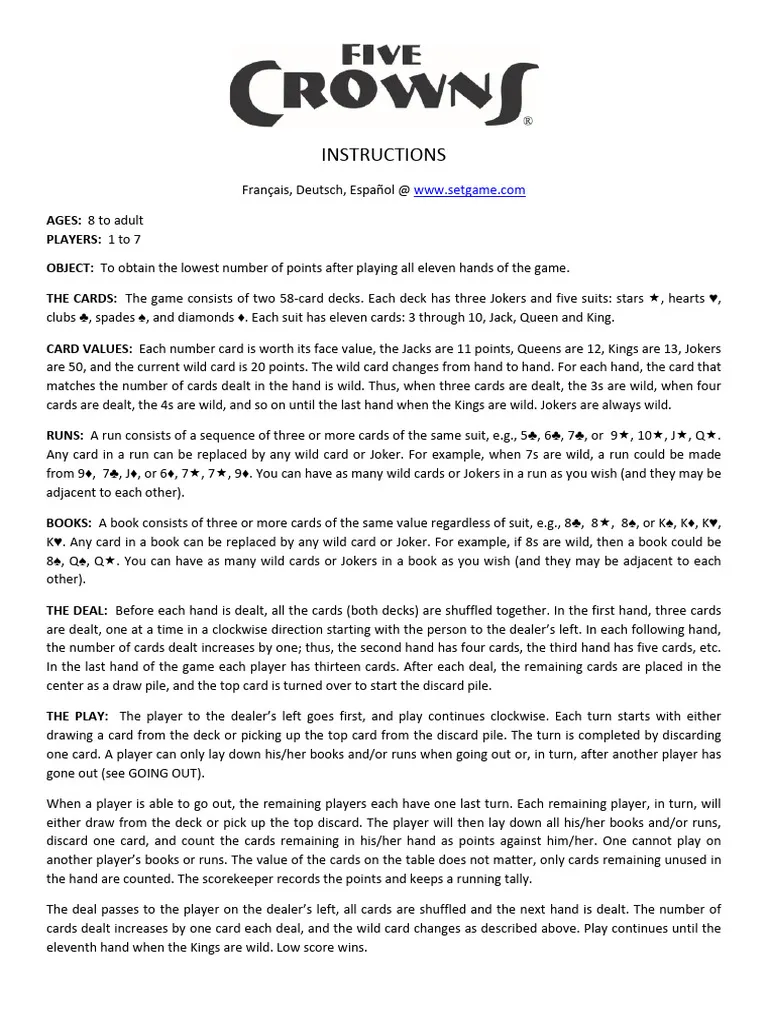
The deck is a double deck built around five suits, adding a Stars suit alongside the usual four. The game then stacks two wildcard systems:
-
Jokers are always wild.
-
The rotating wild rank changes each round based on the number of cards dealt—3s when 3 cards are dealt, 4s when 4 cards are dealt, and so on, until Kings go wild in the final round.
That rotating-wild idea is the whole personality of Five Crowns. It creates hands where yesterday’s “dead card” is suddenly gold.
How the game runs at a typical U.S. table
The official structure is steady: players try to finish with the lowest score after eleven hands, forming melds (books and runs) to get rid of points.
A common reason it sticks in American homes is the pacing: it supports 1–7 players, and the expected play time is around 45 minutes—long enough to feel like a real game, short enough to fit a weeknight.
The core loop stays familiar for beginners:
-
draw one card,
-
discard one card,
-
quietly build books/runs in your hand,
-
“go out” when you can lay everything down (usually with one final discard).
If rummy is a language, Five Crowns is a dialect: understandable, but with a few words that change meaning every round.
Why Five Crowns fits U.S. card culture so well
A lot of classic American card-night favorites share two traits: they’re teachable fast, and they leave room for comebacks. Five Crowns does both.
Even mainstream coverage has described it as fast-paced, with a shifting wild card that can flip the outcome late—especially because the last hand is so large and the wilds are so powerful. It also wears its influences openly: it’s often described as combining familiar elements from rummy-style play and more modern “set-collection” card games.
Part of the appeal of five crowns in United States is that it works across generations without feeling “for kids” or “for adults.” The learning curve is gentle, but the decision-making stays real: when to hold a potential run, when to dump points, when to gamble on the next round’s wilds saving you.
House rules you’ll hear (and why they happen)
Because it’s a home-friendly game, people tinker. The most common “variations” aren’t new mechanics—they’re little fairness knobs:
-
stricter rules about when you’re allowed to lay down melds
-
a rule about not picking up a discard you just threw away
-
an agreement on how to handle misdeals or exposed cards
-
faster scoring shortcuts to keep momentum
None of these are required, but they’re predictable. When a game becomes a regular in U.S. living rooms, players start sanding off friction points so the night stays smooth.
The modern footprint: still physical, now also “searchable”
Five Crowns didn’t stay alive only through nostalgia. It kept showing up as a current product—with a published rules PDF and periodic new packaging—plus anniversary attention (including a 25th Anniversary Edition announcement that framed it as a long-running game-night favorite).
It also has a secondary life through digital adaptations and references (including a dedicated app that mirrors the eleven-hand structure). For players, that matters less as “technology” and more as continuity: you can revisit the rules, settle a dispute, or teach a new group without hunting for a paper insert.
Educationally, that’s where a reference site earns its keep too—documenting terminology, clarifying edge cases, and recording how variants differ, so “we played it this way” doesn’t turn into “we played it wrong.”
One small thing beginners miss
New players often focus on making pretty melds and forget the real engine: wild cards change what’s safe to keep. A hand that looks hopeless in Round 6 can become salvageable if you stop hoarding and start managing points—dumping high cards early, keeping flexible connectors, and remembering that the next deal rewrites what “useful” means. Once people internalize that, the game gets calmer, and the choices get sharper.
Five Crowns is a modern American classic because it respects what people already love about rummy—then adds just enough instability to keep every round fresh. That’s why five crowns in United States still shows up as a dependable game-night pick: familiar hands, shifting wilds, and a finish line that keeps everyone paying attention until the Kings go wild.
